


The Berlin-based operation describes itself as a global image-rights enforcement platform that identifies potential copyright infringements and pursues compensation or retrospective licensing on behalf of photographers, agencies and other rights holders.
Copytrack says its goal is to resolve copyright disputes through what it calls a “friendly, fair and effective approach”, allowing recipients to provide evidence of an existing licence, pay compensation or purchase a retrospective licence.
There is nothing inherently improper about enforcing copyright. Photographers and image owners have legitimate rights to seek compensation when their material is used without permission, and European law expressly permits damages to take account of lost licensing revenue or the royalties that would reasonably have been paid.
Australian copyright law likewise generally requires permission to use protected images unless an exception applies.
The controversy surrounding Copytrack instead centres on how potential infringements are detected, how allegations are communicated, whether sufficient evidence of ownership and authority is provided before money is demanded, and what happens when recipients dispute the claim.
Those questions are no longer based solely on angry internet reviews. They have reached regulators.
Italian regulator investigated Copytrack’s copyright demand practices
One of the most significant examinations of Copytrack’s practices was conducted by Italy’s competition and consumer protection authority, the Autorità Garante della Concorrenza e del Mercato, or AGCM.
The regulator opened proceeding PS12629 against Copytrack in October 2023 following consumer reports.
According to the authority’s final decision, Copytrack had sent multiple standardised emails to website administrators, personal bloggers, consumers and microbusinesses seeking payments relating to allegedly unauthorised publication of images and offering annual licences.
The regulator’s investigation raised concerns over whether recipients were being given adequate information about Copytrack’s mandate, the basis of the claim, the copyright allegedly infringed and the agreements recipients were being asked to enter into.
AGCM also examined whether Copytrack’s communications sufficiently informed recipients that a copyright allegation could potentially be challenged on grounds other than producing a licence, including applicable copyright exceptions and limitations.
More significantly, evidence recorded in the regulator’s decision found that Copytrack’s standard emails were capable of inducing recipients to make the requested payments because of both their wording and repeated references to possible criminal implications.
The authority said information concerning ownership of the images, Copytrack’s mandate and the legal basis of the demands had been insufficient, including because some information was provided only if requested.
The regulator also recorded an apparent problem familiar to many people who have complained publicly about the company: when recipients attempted to justify why their use was lawful by replying to Copytrack, the company would send the same standard email again without modification.
AGCM described this as having a discouraging effect on further attempts by recipients to defend themselves.
These findings are particularly significant because complaints about repetitive or automated responses continue to appear in public reviews during 2025 and 2026.
Copytrack agreed to change its practices
Copytrack made a series of changes while the Italian investigation was underway.
According to the regulator, the company modified its standard email to clarify its role, acknowledge that recipients could challenge claims using legal grounds other than a licence, provide additional information within its settlement portal and create an area where recipients could submit explanations about an image’s use.
The company also increased an initial response period from seven to 10 days and said it would evaluate explanations submitted by users on their merits rather than relying solely on automated correspondence.
Copytrack ultimately offered further binding commitments specifically for Italian cases.
Among them was a commitment to apply stricter criteria before pursuing alleged infringements and to abandon certain claims involving individuals and microbusinesses where images appeared on webpages without an immediate commercial purpose.
Copytrack also agreed that Italian consumers would initially receive an information request rather than an immediate financial demand.
A second communication containing a compensation figure or post-licence offer would only follow where the first response was absent or considered unsatisfactory.
The company additionally committed to explaining how claimed damages had been calculated and providing clearer information about the legal basis of its activities.
AGCM accepted those commitments and closed the investigation in November 2024 without making a finding that Copytrack had breached the law.
That distinction is important. The decision should not be represented as a ruling that Copytrack was operating illegally or running a scam.
However, the authority considered the commitments sufficient to address what it called the possible unfair aspects of the practices under investigation and made the commitments legally binding. AGCM
Italy’s regulator later described the original investigation as involving alleged aggressive conduct through persistent standardised emails that could induce consumers into costly transactions concerning allegedly unauthorised image use.
Hundreds of complaints tell a similar story
The regulatory findings become more notable when compared with the volume of public complaints now surrounding the company.
As of late September 2026, Copytrack’s Trustpilot profile showed a score of approximately 1.1 out of 5 from more than 820 reviews, with about 95 per cent recorded as one-star reviews.
Trustpilot expressly warns that reviews represent individual opinions and may not necessarily provide a representative picture of a company, so these figures should not be treated as independently established evidence of wrongdoing.
Nevertheless, the consistency of the allegations is striking.
Recent reviewers have alleged that Copytrack demanded payments concerning images they say were legitimately sourced from services including Adobe Stock, Freepik, Canva, Pixabay and other stock-image platforms.
Several complainants say cases were eventually withdrawn after documentation was provided or after they demanded evidence establishing the alleged rights holder’s ownership.
Others claim that documentation was initially ignored while payment reminders continued.
One September 2026 reviewer said Copytrack sought almost €500 over an image the recipient said was available through Pixabay.
According to the reviewer, repeated requests were made for evidence showing ownership, the basis for the amount claimed and jurisdiction before Copytrack eventually closed the case.
Another reviewer alleged receiving a claim over an image that had been purchased and licensed through a legitimate stock provider.
These accounts remain allegations by reviewers and Tech Business News has not independently examined the underlying licensing documentation for each case.
They nonetheless resemble the communication problem documented independently by the Italian regulator.
Allegations of image matching errors
A particularly concerning category of complaints involves cases where recipients say Copytrack identified the wrong photograph entirely.
In July 2026, one reviewer alleged that Copytrack’s system had matched a photograph of a computer keyboard against another keyboard image despite visible differences between them.
The reviewer said attempts to explain the discrepancy were followed by further messages asserting copyright infringement. Trustpilot
Another complainant said they obtained the original RAW photographic file and metadata from the contributor who supplied an image, but claimed Copytrack’s communications continued to request a purchase receipt or licence rather than addressing the provenance evidence supplied.
These allegations matter because Copytrack’s system is built around large-scale image detection.
The Italian investigation described a process in which rights holders upload portfolios to Copytrack’s software, which searches for possible unauthorised online publication.
Potential matches are then presented to the rights holder, who can authorise Copytrack to pursue the alleged infringement.
Automating the discovery of images makes large-scale enforcement possible, but it also makes verification an important safeguard where visually similar photographs, sublicensing arrangements, stock-library distribution or historical licences are involved.
Who must verify ownership?
Copytrack’s own current enforcement terms shed further light on this issue.
Those terms require rights holders using the service to thoroughly examine the factual and legal situation before submitting a case.
Where a rights holder derives ownership through another party, Copytrack says that customer must be capable of providing court-usable evidence establishing the chain of rights.
Its terms also contemplate cases being closed where a valid licence existed and the rights holder knew or reasonably should have known about it. Copytrack can, under those circumstances, seek its expenses from its own client.
That contractual language suggests Copytrack itself recognises the risk posed by inaccurate claims or incomplete ownership information.
The recurring public complaints raise the separate question of how consistently those safeguards operate before an alleged infringer receives a demand.
A financial incentive built into successful recoveries
Copytrack operates on a success-fee model.
Its published enforcement terms state that it receives 45% of recovered payments for retrospective licensing, commercial dunning, out-of-court enforcement and judicial enforcement, after applicable enforcement costs. COPYTRACK
A contingency-style model is not itself evidence of improper behaviour and is common across debt recovery and legal-enforcement services.
It does, however, mean that Copytrack has a direct financial interest in successfully converting identified image matches into settlements or licence payments, making accurate verification particularly important.
The company’s terms say retrospective licence prices are intended to reflect what a rights holder and a third party would reasonably have agreed for comparable use.
Where settlement is unsuccessful and Copytrack considers the case sufficiently strong, the company says it may pursue damages or have third parties pursue them.
Payment demands can considerably exceed ordinary stock-image prices
Another recurring complaint involves the difference between the amount demanded and what recipients say the image originally cost through a stock library.
Public reviews regularly refer to demands running into hundreds of euros for individual images, including images reviewers say were available inexpensively through subscription services or stock platforms. Trustpilot
That comparison can, however, be misleading if treated in isolation.
Copyright damages are not necessarily limited to what a stock photograph would cost today. Under European intellectual-property enforcement law, damages may take into account lost profits, royalties that should have been paid and other relevant losses
The genuine public-interest issue is therefore not simply that Copytrack’s demands can exceed a stock site’s download price. It is whether the claimant has established ownership, unauthorised use, an enforceable entitlement to compensation and a defensible basis for the amount being demanded.
German lawyers have raised separate concerns
Copytrack has also attracted criticism from German legal practitioners.
German law firm KEHL Rechtsanwaltsgesellschaft published an analysis in 2024 arguing that aspects of Copytrack’s activities went beyond ordinary debt collection and could constitute legal services requiring appropriate authorisation.
The firm said it had submitted a complaint to Germany’s Federal Office of Justice.
That is the law firm’s legal position, not a judicial finding against Copytrack.
Copytrack’s current website identifies the business behind the service as RD Legal GmbH and states that it is registered in Germany’s Legal Services Register under the German Legal Services Act for collection services.
Copytrack GmbH became RD Legal GmbH
Corporate records show another significant change.
COPYTRACK GmbH was officially renamed RD Legal GmbH in 2025, while Copytrack continues to operate as a brand.
German corporate documentation records the name change, while Copytrack’s current imprint identifies RD Legal GmbH as the legal entity operating from Berlin.
The renaming is a corporate fact and should not itself be interpreted as evidence of wrongdoing.
However, recipients researching a copyright demand may now encounter several names associated with the operation, including Copytrack and RD Legal GmbH, which can make independently checking the organisation and historic complaints more complicated.
Copytrack says ignoring claims may lead to lawyers
Copytrack’s own frequently asked questions make clear that the company considers its claims serious.
It says unresolved matters can be handed to partner lawyers in the recipient’s jurisdiction and warns that legal escalation may increase costs.
The company also states that recipients are entitled to obtain legal advice and can request additional time to investigate whether a valid licence exists.
Its public terms state that once a recipient pays a settlement, the particular damages claim covered by that settlement is resolved, although continuing use of the image is generally prohibited unless a licence has separately been obtained.
For this reason, dismissing every Copytrack notice as fraudulent would be dangerous.
A real photographer whose copyrighted image has genuinely been used without permission can have a valid claim, regardless of whether the infringement was deliberate.
The same principle applies in Australia, where using copyright material without permission can constitute infringement unless an applicable licence or statutory exception exists.
Australian law also recognises fair-dealing exceptions for purposes including reporting news, criticism, review, research and parody, subject to their respective requirements.
The bigger issue is due process before payment
The Copytrack controversy therefore sits somewhere more complicated than the labels frequently applied to it online.
There is clear evidence that Copytrack is a real German company engaged in copyright enforcement, that copyright holders have legitimate legal rights, and that Copytrack’s business model provides a mechanism for those rights to be pursued.
There is also clear documentary evidence that a European consumer regulator became sufficiently concerned about aspects of Copytrack’s communications to conduct a formal investigation, finding problems including insufficient information, intimidating elements in standardised communications and ineffective responses when recipients attempted to defend themselves.
Copytrack subsequently agreed to substantial changes and the regulator closed the matter without finding an infringement of consumer law.
What remains unresolved is why, nearly two years later, public complaints continue to describe remarkably similar experiences, including claims involving allegedly licensed images, repetitive responses and demands that recipients say disappear once ownership or licensing evidence is challenged.
Those complaints do not establish that every demand is invalid, nor do allegations describing Copytrack as a “scam”, “extortion” or a “copyright troll” establish criminal or unlawful conduct.
They do establish something worthy of continuing scrutiny.
When automated technology can identify thousands of possible infringements and a company receives a percentage of successful recoveries, the accuracy of the original match, proof of the claimant’s rights, meaningful review of contrary evidence and transparency of the amount demanded become fundamental safeguards.
For photographers, there is a legitimate public interest in stopping companies and websites from exploiting creative work without payment.
For publishers, businesses and ordinary website owners, there is an equally legitimate interest in ensuring they are not pressured into paying substantial sums for images they were already entitled to use.
Copytrack’s continuing challenge is demonstrating that a system capable of enforcing copyright at enormous scale can distinguish reliably between those two groups.
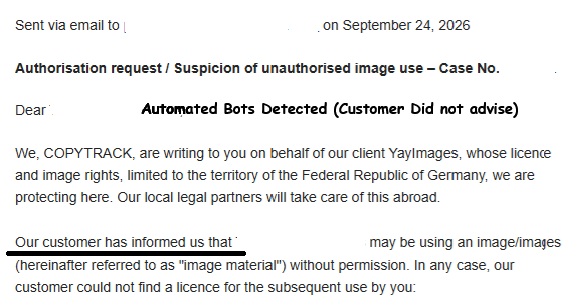
2026 – Copytrack Found Falsifying Reports
Recently in 2026, Copytrack was observed sending copyright payment demands that stated, or appeared to state, that its clients had directly contacted the company after identifying unauthorised use of their images.
Evidence reviewed in at least one case appeared to contradict that account, indicating that the image had instead been detected by Copytrack’s automated image-monitoring or scraping systems, which then triggered the generation of falsified report from the copyright holder and sent to the accused.
The material raised questions about whether recipients were being given an accurate impression of the copyright holder’s direct involvement in initiating the claim.
The initial detection and contact process appeared to have been automated rather than prompted by a specific complaint from the rights holder.
Editor’s note: Public reviews cited in this investigation represent allegations made by individual reviewers and have not, unless otherwise stated, been independently established in court.
The Italian AGCM proceeding against Copytrack concluded through binding commitments without a finding that the company had violated consumer law.
Copytrack’s current website states that its operator, RD Legal GmbH, is registered under Germany’s Legal Services Act.