Whether you’re a cybersecurity professional, network engineer, or tech learner, the OSI (Open Systems Interconnection) Model remains one of the most critical frameworks in networking.
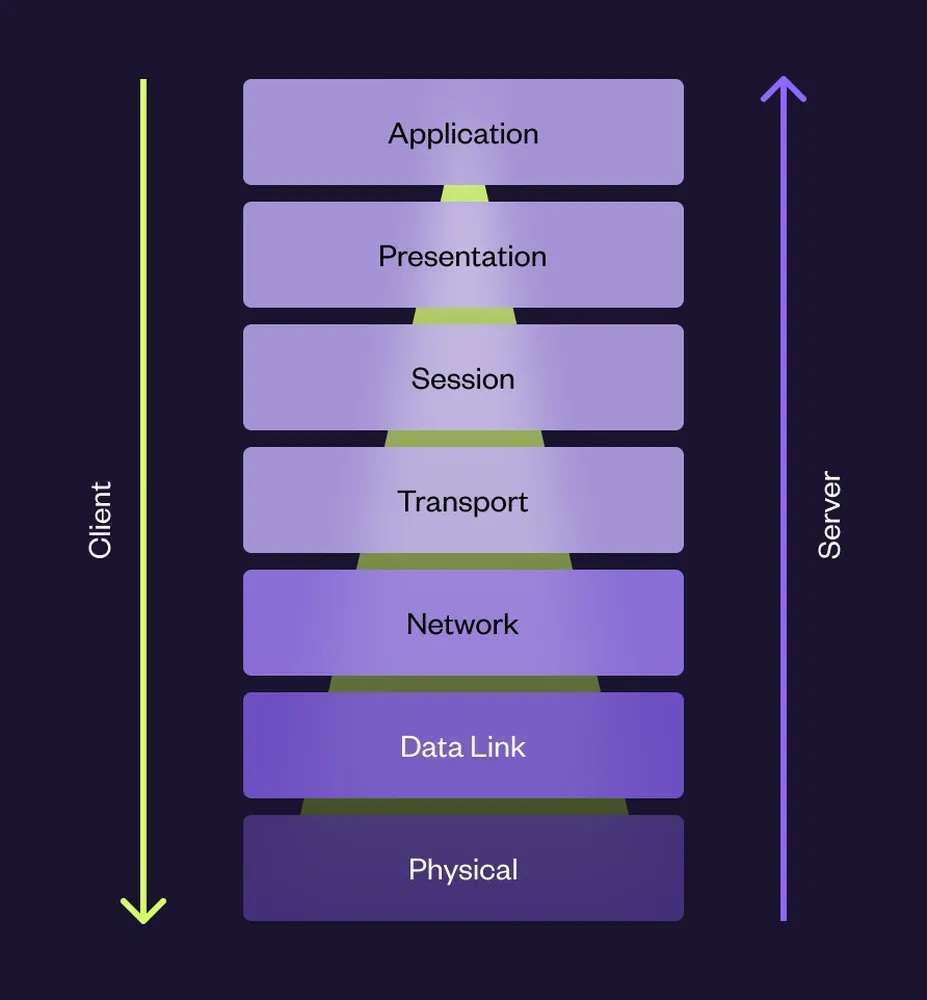
It breaks down network communication into 7 layers, making it easier to design, troubleshoot, and secure complex systems:
🔹 Layer 1 – Physical: Cables, signals, bits
🔹 Layer 2 – Data Link: MAC addressing, switches
🔹 Layer 3 – Network: Routing, IP addressing
🔹 Layer 4 – Transport: TCP/UDP, reliable delivery
🔹 Layer 5 – Session: Session control & communication
🔹 Layer 6 – Presentation: Data formatting & encryption
🔹 Layer 7 – Application: User-facing protocols (HTTPS, DNS, SMTP…)
OSI MODEL DEVELOPMENT
- Initial development: The development process began in the late 1970s, with a merged proposal from the ISO and the CCITT being finalised in May 1983.
- First publication: The model was published in its first form as the standard ISO 7498 in 1984.
- Current version: The current and latest version of the standard is ISO/IEC 7498-1:1994.
What is the OSI Model?
The OSI (Open Systems Interconnection) model serves as a fundamental framework for understanding how network communication occurs between systems.
By dividing networking functions into seven distinct layers—Physical, Data Link, Network, Transport, Session, Presentation, and Application—it provides a clear structure that simplifies troubleshooting, design, and implementation of network systems.
Each layer has its own unique responsibilities, from transmitting raw data across physical media to enabling end-user applications to communicate seamlessly.
🔹 Layer 1 – Physical (Hardware & Transmission Media)
Function:
The Physical layer is responsible for the actual transmission of raw binary data (bits) over a physical medium. It defines the hardware elements involved in networking, such as cables, connectors, voltage levels, signal timing, and network interface cards (NICs).
This layer converts data into electrical, optical, or radio signals for communication between devices.
Examples:
Ethernet cables, fiber optics, hubs, switches (at physical level), Wi-Fi signals, connectors (RJ45).
🔹 Layer 2 – Data Link (Node-to-Node Communication)
Function:
The Data Link layer ensures reliable communication between two directly connected nodes. It packages raw bits into frames, detects and sometimes corrects errors from the physical layer, and controls how devices access the network medium.
It also handles MAC (Media Access Control) addressing, allowing devices to identify each other on the same local network.
Examples:
Ethernet, MAC addresses, switches (logical function), ARP (Address Resolution Protocol), PPP (Point-to-Point Protocol).
🔹 Layer 3 – Network (Routing & IP Addressing)
Function:
The Network layer is in charge of data delivery between different networks. It determines the best path for data to travel and handles logical addressing through IP (Internet Protocol). This layer breaks data into packets and routes them across multiple networks using routers.
Examples:
IP (IPv4/IPv6), routers, ICMP (Internet Control Message Protocol), IP addressing, routing protocols like OSPF, RIP, and BGP.
🔹 Layer 4 – Transport (End-to-End Communication)
Function:
The Transport layer ensures reliable data transfer between devices. It manages error recovery, flow control, segmentation, and reassembly of data. It can provide connection-oriented communication (TCP) or connectionless communication (UDP), depending on the need for reliability versus speed.
Examples:
TCP (Transmission Control Protocol), UDP (User Datagram Protocol), port numbers, error detection, and retransmission mechanisms.
🔹 Layer 5 – Session (Connection Management)
Function:
The Session layer is responsible for establishing, maintaining, and terminating sessions between two devices. It keeps track of ongoing data exchanges (sessions) and ensures that the communication remains synchronized. It also manages session checkpoints and recovery, so if a connection is lost, it can resume without restarting entirely.
Examples:
API calls, remote procedure calls (RPC), NetBIOS, session restoration during communication.
🔹 Layer 6 – Presentation (Data Translation & Encryption)
Function:
The Presentation layer acts as the translator between the application and network. It ensures that data sent from one system can be understood by another, regardless of their internal data formats.
This includes data compression, encryption, and character encoding (e.g., converting EBCDIC to ASCII). It makes sure data is presented in a readable, usable format.
Examples:
SSL/TLS encryption, JPEG, MPEG, GIF, ASCII, data compression formats.
🔹 Layer 7 – Application (User Interaction & Services)
Function:
The Application layer is the closest layer to the end user. It provides network services directly to applications that interact with users, such as web browsers, email clients, and file transfer tools. It defines protocols for user services like web browsing, email, and domain name resolution.
Examples:
HTTP/HTTPS (web browsing), SMTP (email), FTP (file transfer), DNS (domain resolution), SNMP (network management).
Together, these layers promote interoperability between different hardware and software, allowing diverse systems to connect and exchange data efficiently.
In essence, mastering the OSI model is essential for anyone working with computer networks. It not only deepens technical understanding but also enhances the ability to analyze, design, and maintain robust and reliable communication systems in today’s interconnected world.
💡 Mastering these layers is essential for diagnosing network issues, improving performance, and strengthening security architectures — especially in the era of cloud networking and Zero Trust.
👨💻 If you’re building a cybersecurity or networking career, learning OSI fundamentals isn’t optional — it’s a must.