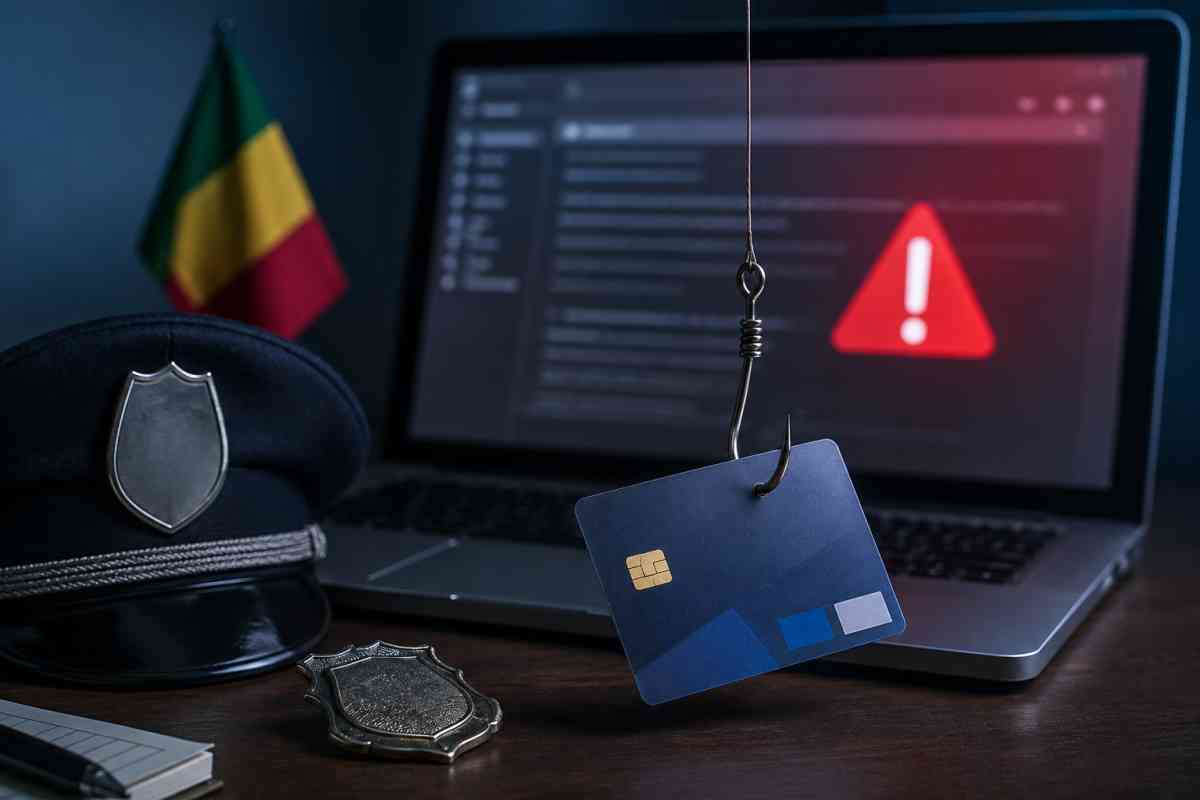


An email claiming police in the Republic of Benin have recovered a stolen ATM card is making the rounds in what may be one of the most pathetic scam attempts seen in 2026.
The message claims to come from the “Commissariat Central” at the “HEAD QUARTER POLICE STATION ZOGBO COTONOU”, but any appearance of authority disappears within the first few lines.
The email is riddled with grammatical errors, broken English, a ridiculous story and enough obvious warning signs to make even the most inexperienced internet user suspicious.
The supposed police officer claims a “Ghanian Citizen” working for DHL was arrested with an ATM card bearing the recipient’s name.
The email also alleges the card was contained in a parcel with documents proving ownership, along with its four-digit PIN.
That alone makes little sense. Banks don’t normally send an activated ATM card and its PIN together in an unsecured parcel, while police would not identify a supposed beneficiary by sending an unsolicited email and asking the person to hand over more personal information.
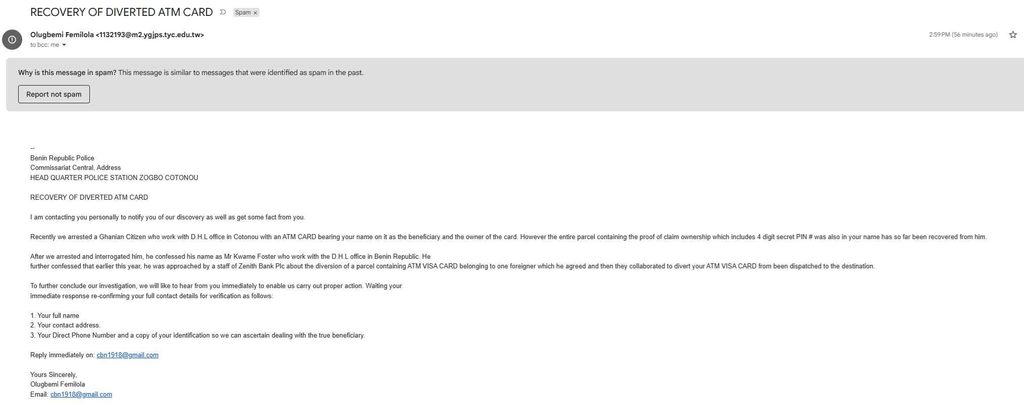
The story becomes even more absurd when the alleged DHL employee, named as “Mr Kwame Foster”, supposedly confesses that he worked with a Zenith Bank employee to divert an ATM Visa card intended for an unnamed foreigner.
The recipient is never told which bank issued the card, what account it belongs to, why the card was created or how the supposed police officer obtained their email address.
Despite claiming to have recovered a parcel containing proof of ownership, the sender then demands the recipient provide their full name, home address, direct phone number and a copy of their identification.
This is the real purpose of the email. The elaborate story about corrupt bank workers, stolen parcels and police investigations is simply bait intended to convince recipients to surrender enough personal information for identity theft or further fraud.
The sender also demands an immediate response, a common tactic used to create urgency and stop victims from taking time to examine the message properly.
Anyone who replies may later be told they must pay a release fee, delivery charge, police clearance fee, tax or some other invented expense before the nonexistent card can be sent.
Perhaps the funniest part is the email address.
The message claims to come from police in Benin, yet recipients are told to reply to “cbn1918@gmail.com”.
It is a free Gmail address with no connection to an official police domain, DHL or Zenith Bank.
The letters “CBN” would usually be associated with the Central Bank of Nigeria, which has nothing to do with the Benin police story being presented.
Even the sender’s identity offers no reassurance. The email is signed by “Olugbemi Femilola”, but it provides no rank, badge number, official telephone number, government website or verifiable police contact details.
There is no case number either, despite the sender claiming an arrest and investigation have already taken place.
The scam is a badly recycled version of the old advance-fee fraud emails that have circulated for decades.
Instead of promising an inheritance, lottery prize or abandoned fortune, this version uses a supposedly recovered ATM card to create curiosity and the expectation of money.
Recipients should not reply, open attachments or provide identification documents. The email should be marked as phishing and deleted.
Anyone who has already sent personal information should contact their bank, change passwords connected to the exposed email address and consider reporting the incident to the relevant cybercrime or identity protection authority.
Scammers don’t need every recipient to believe the entire story. They only need a small number of people to respond.
However, with a stolen ATM card, a conveniently included PIN, an imaginary police investigation and a Gmail address thrown together in one clumsy message, this attempt barely manages to look convincing enough to qualify as a scam.
Old-style “Nigerian” or 419 emails remain part of a global fraud industry, with criminals now impersonating police, banks and delivery companies.
The FBI’s 2026 report recorded 7,762 advance-fee complaints and US$155.9 million in losses during 2025, while the FTC reported US$3.5 billion lost to impersonation scams.