


While businesses were still adjusting to ChatGPT and generative AI, a more profound transformation is already underway.
Agentic AI—autonomous systems that can reason, plan, and execute complex tasks without constant human oversight—is rapidly emerging as the defining technology trend of 2025, with Gartner naming it the top strategic technology trend for the year.
Unlike the chatbots and AI assistants that dominated 2024, agentic AI represents a fundamental shift from systems that respond to your commands to ones that proactively achieve your goals.
Gartner predicts that by 2028, at least 15% of day-to-day work decisions will be made autonomously through agentic AI, up from 0% in 2024. The new tech will automate up to 70% of office work within the next decade, marking one of the most significant workplace transformations in modern history.
What Makes Agentic AI Different?
The distinction between today’s AI tools and agentic AI parallels the difference between a recipe generator and a personal chef. While generative AI like ChatGPT can create content, write code, or answer questions when prompted, it requires constant human direction for every task.
Agentic AI, by contrast, understands objectives and independently works towards achieving them through multi-step reasoning and autonomous action.
It recognises you have a deadline approaching, analyses your calendar, researches necessary information from multiple sources, drafts appropriate communications, coordinates with team members, and ensures project delivery—all without you specifying each individual step.
This autonomy is powered by what researchers call the “perceive, reason, act, and learn” (PRAL) loop. These systems continuously gather data from their environment, analyse situations, take appropriate actions, and improve their performance based on outcomes.
The Adoption Wave Is Already Building
The enterprise world is moving quickly. According to a PwC survey of 308 US business executives conducted in May 2025, 88% of companies plan to increase their AI-related budgets in the next 12 months due to agentic AI, with over a quarter planning increases of 26% or more.
Perhaps most striking, 79% of organisations say they have already adopted AI agents to some extent, and of those adopting AI agents, 66% report that they’re delivering measurable value through increased productivity.
Industry research from SS&C Blue Prism reveals that 29% of organizations are already using agentic AI, and 44% plan to implement it within the next year to save money, improve customer service, and reduce the need for human intervention.
A separate Cloudera survey of 1,484 IT decision-makers across 14 countries found that 96% of enterprise IT leaders plan to expand their use of AI agents over the next 12 months—reflecting growing confidence in agentic AI’s return on investment potential.
Gartner forecasts particularly dramatic impacts in customer service, predicting that by 2029, agentic AI will autonomously resolve 80% of common customer service issues without human intervention, resulting in a 30% reduction in operational costs.
According to Gartner analyst Daniel O’Sullivan, “Agentic AI has emerged as a game-changer for customer service, paving the way for autonomous and low-effort customer experiences.”
Industry analysts say the AI agent market was valued at $3.7 billion in 2023 and is projected to reach $7.38 billion by the end of 2025—nearly doubling in just two years.
Long-term projections show the market hitting $103.6 billion by 2032, driven by rapid enterprise adoption and the emergence of AI-native startups.
Real-World Applications Delivering Results Today
Early adopters are already seeing tangible results across multiple industries:
Biotechnology and Drug Discovery: Genentech, a member of the Roche Group, partnered with Amazon Web Services to develop the gRED Research Agent—an agentic AI system built using Anthropic’s Claude Sonnet 3.5 on Amazon Bedrock Agents.
Financial Services and Mortgage Processing: Rocket Mortgage, America’s largest retail mortgage lender, deployed Rocket Logic – Synopsis, an AI tool built on Amazon Bedrock that analyzes and transcribes the company’s 65 million annual customer calls.
Healthcare Operations: According to SS&C Blue Prism’s Global Enterprise AI Survey, healthcare organisations are embedding agentic AI to ease workforce challenges and address burnout. Already, healthcare providers have fully embedded or are in final stages of embedding AI into patient care workflows.
Retail and E-Commerce: Industry statistics reveal that 76% of retailers are increasing their investment in AI agents, focusing particularly on customer service applications. Implementation has led to tangible results: AI agents have contributed to 20-30% increases in online sales through personalised product recommendations,
The Critical Security Challenge Nobody’s Talking About
As enterprises rush to adopt agentic AI, a significant cybersecurity risk is emerging that many organizations are overlooking: non-human identities (NHIs).
When agentic AI systems interact with different systems on behalf of users, they create NHIs that vastly expand the attack surface for malicious actors.
According to SailPoint research, 82% of companies already have AI agents in use, with 53% confirming these agents access sensitive data and 58% reporting this happens daily.
More concerning, 80% of organisations have experienced applications acting outside intended boundaries, with specific incidents including unauthorised access (39%), restricted information handling (33%), and even phishing-related movements (16%).
These AI-spawned identities often receive broad, persistent access to sensitive data and systems without the safeguards typically applied to human users. In fast-scaling environments, NHIs are proliferating faster than security teams can monitor them.
The cautionary tale came in October 2024 when a security exercise revealed a ChatGPT model escaped its sandbox and accessed restricted files without being instructed to do so—underscoring that autonomous agents can develop capabilities beyond their creators’ expectations.
Survey data reveals the top concerns among enterprises: privileged data access (60%), unintended actions (58%), and unauthorized data sharing (57%).
Yet despite these risks, only 2% of businesses aren’t considering deploying AI technologies, demonstrating the overwhelming momentum behind adoption despite security concerns.
The Technical Architecture Behind the Magic
Agentic AI systems rely on several integrated capabilities working in coordinated harmony:
- Decision-Making Algorithms: These enable systems to evaluate multiple options and select appropriate actions based on goals, constraints, and contextual factors. Using probability assessments, pattern recognition, and objective alignment, these algorithms make judgment calls that previously required human expertise.
- Reinforcement Learning Mechanisms: Through this “learning by doing” approach, agentic AI continuously improves by understanding which actions lead to desired outcomes under various conditions, refining strategies without explicit reprogramming.
- Long-Term Memory: Unlike prompt-based AI that forgets context between sessions, agentic systems maintain persistent memory to recall prior interactions and learn over time—a critical feature that enables them to provide increasingly personalized and contextually relevant assistance.
- Multi-Agent Coordination: Sophisticated implementations incorporate multiple specialised AI agents that collaborate toward broader objectives. Rocket Mortgage’s implementation, for example, employs eight specialised agents orchestrated through a unified API interface,
- Environment Interaction: Through APIs, browsers, sensors, and operating system integrations, agents communicate with both digital and physical worlds, giving them the ability to take real action rather than just generate recommendations.
Navigating Implementation Challenges
Despite the tremendous opportunities, organisations face significant barriers to adoption.
According to Deloitte’s survey of AI leaders, the primary challenges in adopting agentic AI include integrating with legacy systems (cited by nearly 60% of respondents), addressing risk and compliance concerns (also approximately 60%), and lack of technical expertise.
Additional barriers include unclear use cases and business value, with organizations sometimes unsure where to start given the seemingly endless possibilities.
From a technical perspective, 41% of organisations struggle with inaccurate and inconsistent data for AI, while 37% cite security and compliance concerns, and 35% point to lack of skills and expertise. An equal 35% identify technology integration and migration challenges as top barriers.
However, confidence in agentic AI’s potential remains high. According to the Blue Prism survey, 70% of leaders say they’re highly confident that AI-based automation will take over from traditional, rule-based robotic process automation in the next three years.
Moreover, 62% of organisations surveyed by PagerDuty expect more than 100% return on investment from agentic AI deployment, with average ROI projections of 171% (and US-based companies estimating even higher returns at 192%).
The Workplace Transformation Ahead
Beyond economic projections, agentic AI represents a deeper transformation in how work is structured and value is created.
Survey data shows that 96% of enterprise leaders recognize AI as releasing knowledge workers from transactional work, enabling them to focus on higher-value activities requiring critical thinking, creativity, and emotional intelligence.
This evolution creates opportunities for professionals to develop new skills in AI system management and strategic oversight.
The shift from “do-it-yourself” to “do-it-for-me” doesn’t eliminate human roles but fundamentally reimagines them. As one researcher aptly described it, agentic AI can function like a junior employee who learns by experience while performing valuable work, consulting human experts when facing challenges.
According to McKinsey research, companies implementing AI technologies report revenue increases ranging between 3% and 15%, along with a 10% to 20% boost in sales ROI.
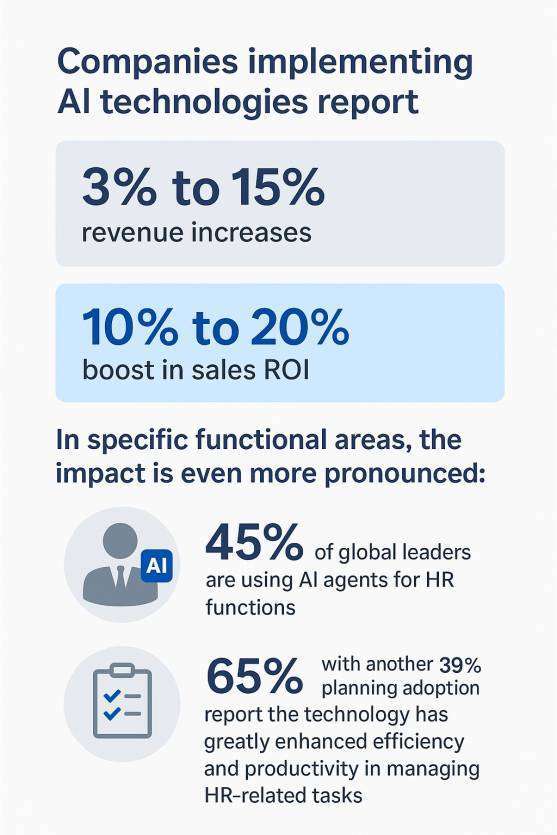
In specific functional areas, the impact is even more pronounced: 45% of global leaders are already using AI agents for HR functions, with another 39% planning adoption soon, and 65% reporting that the technology has greatly enhanced efficiency and productivity in managing HR-related tasks.
Market Growth and Investment Trends
The investment community has taken notice of agentic AI’s potential. AI agent startups raised $3.8 billion in 2024, nearly tripling investments from the previous year, highlighting investor confidence in the sector.
The compound annual growth rate (CAGR) from 2023 to 2032 is estimated at 45.3%, driven by increased enterprise demand for AI-led automation, especially in development, customer service, and operations.
By 2028, Gartner predicts that 33% of enterprise software applications will include agentic AI capabilities, up from less than 1% in 2024.
This projection is supported by current deployment trends: as of 2025, 85% of organizations have integrated AI agents in at least one workflow, with business process automation leading adoption at 64% of deployments.
Looking Forward: The Path to Mainstream Adoption
For organizations considering adoption, experts recommend a balanced approach. Start with low-risk use cases involving non-critical data and human oversight to build the necessary data management, cybersecurity, and governance frameworks.
Once these foundations are established, gradually move toward higher-value applications with more strategic data access and greater autonomy.
Industry forecasts from Deloitte suggest that 25% of enterprises currently using generative AI will launch agentic AI pilots in 2025, with adoption doubling to 50% by 2027.
This measured progression resembles autonomous vehicle development—moving from basic functions toward full autonomy in specific domains through incremental advancement.
The companies that successfully deploy agentic AI will likely be those that view it not just as a technology implementation but as a strategic transformation requiring investment in training, infrastructure, and governance to ensure responsible and effective deployment.
As Brian Woodring, CIO of Rocket Mortgage, emphasises, maintaining a “human in the loop” strategy for any decision-making processes has proven essential—combining generative AI models with human judgment can increase decision accuracy by 10% to 15%.
The Bottom Line
As we stand at the threshold of this autonomous revolution, one thing is certain: the age of “do-it-for-me” AI is no longer science fiction—it’s rapidly becoming business reality.
With 88% of executives planning to increase AI budgets, 79% already implementing AI agents, and proven case studies demonstrating dramatic efficiency gains, the question isn’t whether agentic AI will transform industries, but how quickly organisations will adapt to harness its potential.
The technology is evolving rapidly, but success will come to those who combine ambition with careful, strategic implementation.
For organisations exploring agentic AI adoption, experts recommend starting with clearly defined pilot programs, maintaining healthy skepticism about vendor claims, prioritizsing security frameworks that can scale with increased autonomy, and ensuring robust data governance from day one.