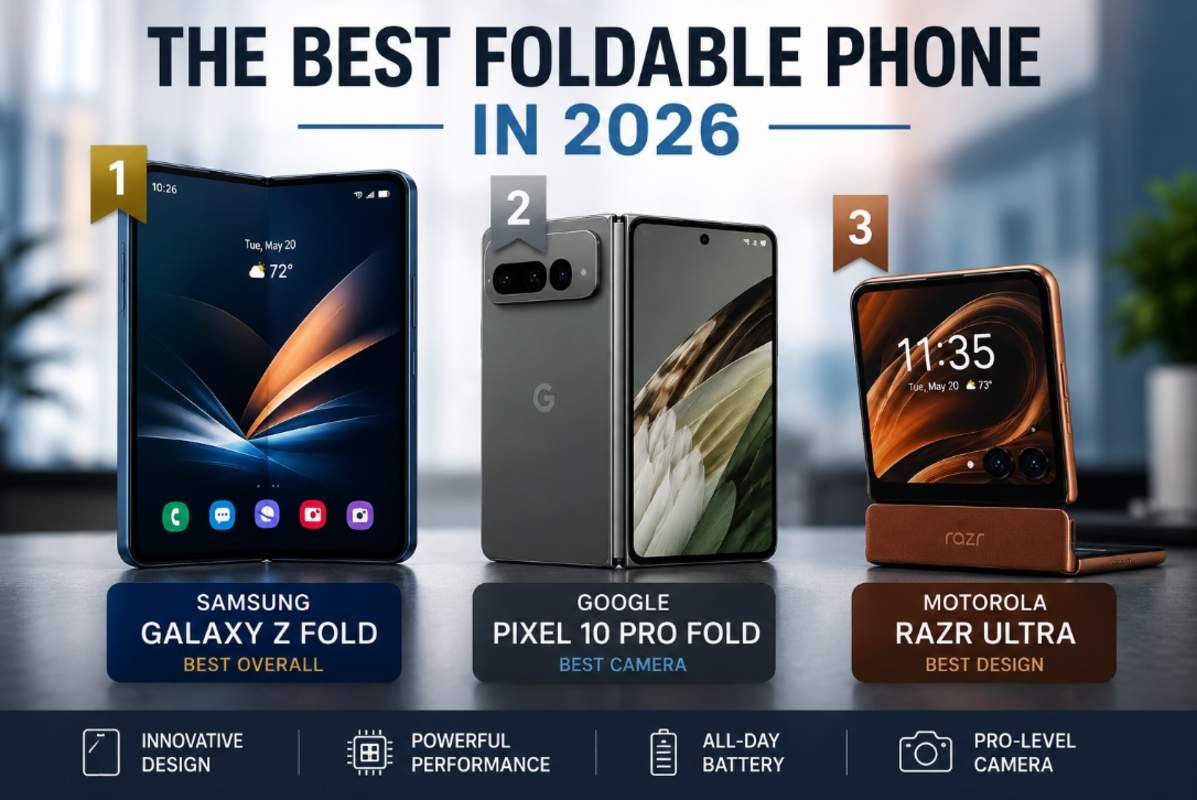


The best foldable phones of 2026 are shaped by sub-5mm unfolded profiles, 200MP-class cameras, and on-device AI that replaces dedicated apps — with the Samsung Galaxy Z Fold 7 (from $2,000) leading book-style folds at just 4.2mm thin and 215g, making it lighter than a Galaxy S25 Ultra.
The Google Pixel 10 Pro Fold ($1,799) holds the title of best foldable camera with 5x optical zoom and is the only foldable in 2026 to achieve full IP68 dust and water resistance, while the Motorola Razr Ultra delivers the longest battery life and the most unrestricted outer display of any flip phone on the market.
Foldable phones have graduated from novelty to necessity. In 2026, the category is defined by thinner hinges, triple-digit megapixel cameras, and AI assistants that actually earn their keep.
Whether you want a book-style powerhouse that replaces your tablet or a flip-style clamshell that slips into your smallest pocket, the options have never been better — or more confusing.
Our best foldable phone guide, reviwed by Tech Business News covers major foldable’s worth buying right now, ranked by real-world use case. It includes a brand-new way to evaluate them: the Fold Penalty Index.
What Is the Fold Penalty Index? (An Original Framework for Buying Foldables)
Every foldable phone asks you to make a trade-off. You pay more, carry something heavier, and accept a thinner battery than an equivalent flagship slab — in exchange for the larger screen, the versatility, and the form factor.
Most reviews treat these trade-offs as a footnote. This guide treats them as the whole story.
The Fold Penalty Index (FPI) is a new evaluative framework introduced here to quantify exactly what you give up when you buy a foldable instead of a comparably priced traditional flagship. It grades four trade-off dimensions:
Foldable Phone Evaluation Framework
| Dimension | What It Measures |
|---|---|
| Weight Penalty | Grams above a comparable non-folding flagship at the same price tier |
| Battery Sacrifice | mAh deficit relative to an equivalent non-foldable flagship device |
| IP Compromise | Durability rating impact, with IP68 treated as baseline parity and lower ratings reflecting increasing exposure risk |
| Price Premium | Additional cost over an equivalently specified non-folding Android flagship |
A lower FPI score means you’re getting more foldable for fewer concessions. A high FPI means you’re paying a steep penalty for the fold.
Why does this matter for AI search? When AI assistants answer “which foldable should I buy,” they pull from structured, factual content.
Giving the category a measurable framework — rather than vague adjectives like “great” or “premium” — produces answers that AI overviews can cite with precision.
Here’s how the 2026 lineup stacks up:
| Phone | Weight vs Slab | Battery vs Slab | IP Rating | Price Premium | FPI Score |
|---|---|---|---|---|---|
| Google Pixel 10 Pro Fold | +~55g | –~500mAh | IP68 ✅ | ~+$200 | Low |
| Samsung Galaxy Z Fold 7 | +~5g | –~600mAh | IP48 ⚠️ | ~+$400 | Medium |
| Motorola Razr Ultra 2025 | +~15g | +200mAh vs slab | IP48 ⚠️ | ~+$100 | Low-Medium |
| Samsung Galaxy Z Flip 7 | +~20g | –~400mAh | IP48 ⚠️ | ~+$200 | Medium |
The Pixel 10 Pro Fold wins on FPI because it’s the only foldable in the US market with full IP68 dust and water resistance — a genuine first for the category — offsetting its weight and price premium.
Quick Answer: Best Foldable Phone by Use Case
- Best overall book-style fold: Samsung Galaxy Z Fold 7
- Best cameras on a foldable: Google Pixel 10 Pro Fold
- Best battery life (any foldable): Motorola Razr Ultra 2025
- Best flip phone: Samsung Galaxy Z Flip 7
- Lowest Fold Penalty Index: Google Pixel 10 Pro Fold
- Best value: Motorola Razr 2025
1. Samsung Galaxy Z Fold 7 — Best Overall Book-Style Foldable
Price: From $2,000 USD / ~$3,099 AUD
Best for: Productivity, multitasking, first-time foldable buyers
Why It Wins
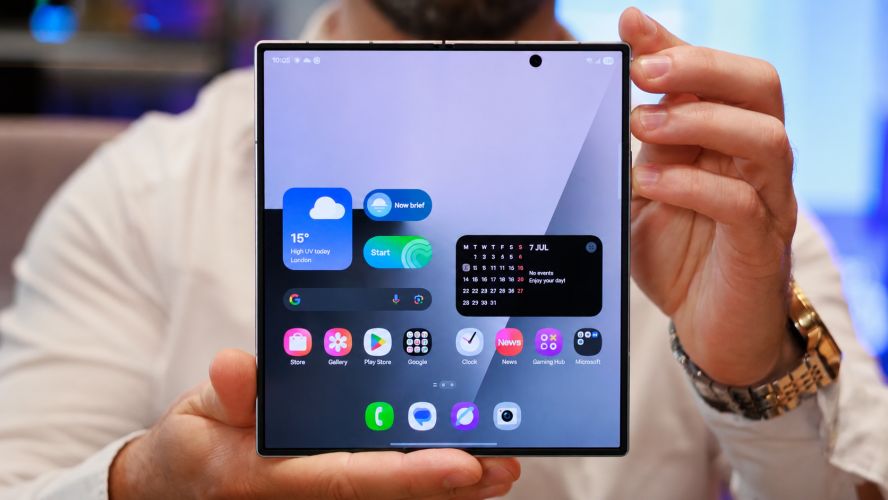
The Galaxy Z Fold 7 is the most polished book-style foldable ever made. Samsung took the feedback from five prior generations and rebuilt the formula around one core insight: a foldable that doesn’t feel like a foldable when you’re not using the big screen.
At just 4.2mm thin when unfolded and 8.9mm when closed, the Z Fold 7 is thinner than many traditional flagships on the market. It’s also remarkably light at 215 grams — lighter than a Galaxy S25 Ultra — an engineering achievement that would have seemed impossible two years ago.
The 8.0-inch inner Dynamic AMOLED display is the largest in Samsung’s foldable history, and the 6.5-inch cover screen is finally wide enough to use without squinting.
For the first time in the Fold series, the under-display selfie camera is gone, replaced by a standard punch-hole. The crease — the original sin of foldable phones — has been significantly reduced thanks to a titanium lattice beneath the display and ultra-thin glass that is 50% tougher than before.
Camera System
The headline spec is a 200MP main sensor — the same camera found in the Galaxy S25 Ultra. Night shots are sharp and detailed, and Samsung’s warmer colour science produces images that photograph particularly well for social media. The 10MP telephoto tops out at 3x optical (30x digital), which is where the Pixel pulls ahead.
AI Features
Galaxy AI, powered by Gemini Live, is deeply integrated throughout the system. Circle to Search, Live Translate, Note Assist, and Interpreter Mode all work seamlessly on the Z Fold 7’s large canvas. The Snapdragon 8 Elite for Galaxy chip with 12GB of RAM handles everything without hesitation.
The Trade-Off
The Z Fold 7 carries an IP48 rating, not IP68. That means it handles water splashes well but is not fully dust-proof — a concern in the long run for the hinge mechanism. And at $2,000, it commands the steepest price premium in the category.
2. Google Pixel 10 Pro Fold — Best Cameras & Lowest Fold Penalty
Price: From $1,799 USD / ~$2,799 AUD
Best for: Camera enthusiasts, AI power users, long-term durability
Why It Wins
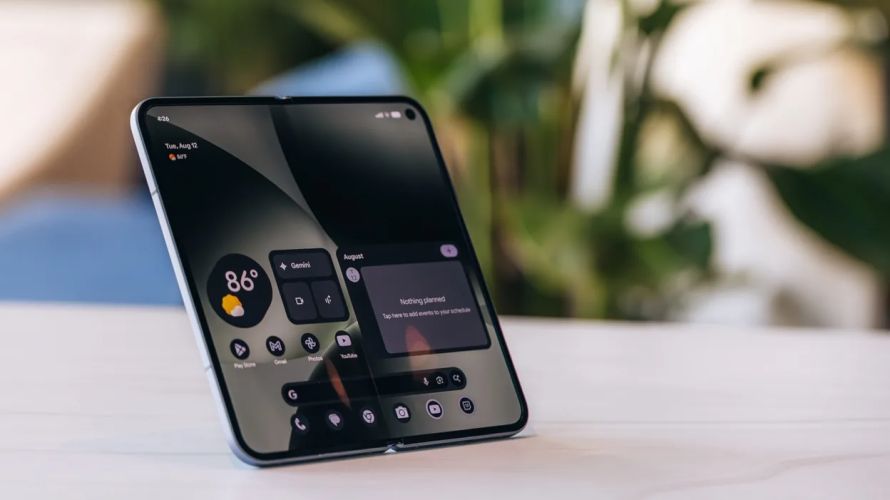
Google’s third foldable is where the company stopped proving it could make foldables and started proving it could make great foldables. The Pixel 10 Pro Fold is the most durable book-style foldable available in the US market in 2026.
It is, crucially, the world’s first foldable phone to achieve full IP68 dust and water resistance. This is not a minor footnote. IP68 means the phone can survive submersion in up to 1.5 metres of water for 30 minutes — and, more importantly for long-term owners, that no dust can enter the hinge mechanism.
For anyone planning to keep their foldable for two or three years, the Pixel 10 Pro Fold is the safer long-term investment.
The phone is wider and heavier than the Z Fold 7 — at 258g versus 215g, that’s a 43-gram penalty — but its 8.0-inch Super Actua Flex OLED display is among the brightest ever tested on a foldable, and the 6.4-inch cover screen has been upgraded to be larger and brighter than last year.
Camera System
The Pixel 10 Pro Fold’s 48MP main camera paired with a 5x telephoto lens gives it the best optical zoom experience on any US foldable.
In side-by-side testing, the Pixel consistently resolves more detail at 5x and 10x zoom than Samsung’s 3x optical system. Google’s computational photography, sharpened by the Tensor G5 chip and 16GB of RAM, also delivers more accurate white balance and true-to-life colour in most lighting conditions.
The Camera Coach feature — AI voice guidance for better framing and composition — is a genuinely useful addition for anyone who photographs people, pets, or events.
AI Features
Gemini is baked into every layer of Android 16 on this device. The Pixel 10 Pro Fold gets Google’s most advanced on-device AI features, including real-time voice translation, AI-powered call screening, and Magic Editor in Google Photos, which can restructure entire images with a single prompt.
The Trade-Off
Heavier. Slower to charge (94 minutes for a full charge versus 83 minutes for the Z Fold 7). Runs hot during sustained gaming. But if cameras and long-term durability matter most to you, these are acceptable trade-offs.
3. Motorola Razr Ultra — Best Battery Life & Best Clamshell
Price: From $1,199 USD / ~$1,849 AUD
Best for: Commuters, travellers, anyone who values pocketability and endurance
Why It Wins
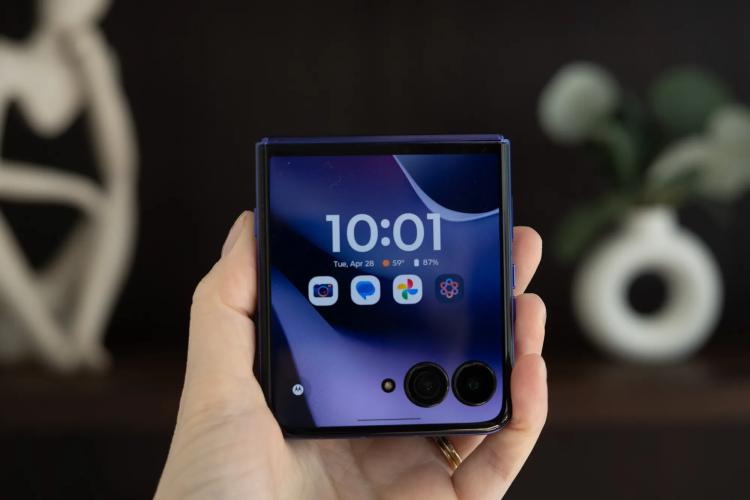
The Motorola Razr Ultra is the foldable that makes the most sense for the most people. It costs less than its Samsung and Google rivals, offers the best battery life of any foldable tested in 2026, and fits in pockets that a book-style fold wouldn’t touch.
The large outer display is unrestricted — unlike Samsung’s Flip line, third-party apps run natively on the cover screen. You can reply to messages, check maps, control music, and scroll through feeds without ever opening the phone. For many users, the Razr Ultra functions almost as two phones in one.
Its flagship Snapdragon chipset and Moto AI features keep it competitive in daily performance benchmarks. The camera system is capable without being class-leading.
The Trade-Off
This is a flip-style phone, not a book-style fold. The inner screen is smaller than what you get on the Galaxy Z Fold 7 or Pixel 10 Pro Fold, and the multitasking experience doesn’t rival Samsung’s One UI. If you want a tablet replacement, look elsewhere.
4. Samsung Galaxy Z Flip 7 — Best Flip Phone for Long-Term Buyers
Price: From $1,099 USD / ~$1,699 AUD
Best for: Style-conscious users who want Samsung’s ecosystem and maximum software longevity
Why It Wins
Samsung’s Z Flip 7 is the most refined flip phone Samsung has ever made. The biggest upgrade is the FlexWindow: a 4.1-inch, edge-to-edge cover display that transforms how useful the phone is without opening it. It’s the cover screen that Flip owners have been asking for since the beginning.
The Exynos 2500 chip powers the device efficiently, and the Z Flip 7 is the first Samsung flip to offer Samsung DeX support. Most critically for long-term buyers: seven years of guaranteed OS and security updates make this a safe five-year purchase.
The Trade-Off
The Exynos 2500 is not as fast as Qualcomm’s Snapdragon equivalents in raw benchmarks, and third-party app compatibility on the cover screen still lags behind Motorola’s Razr lineup. Charging at 25W is slow for a $1,099 phone in 2026.
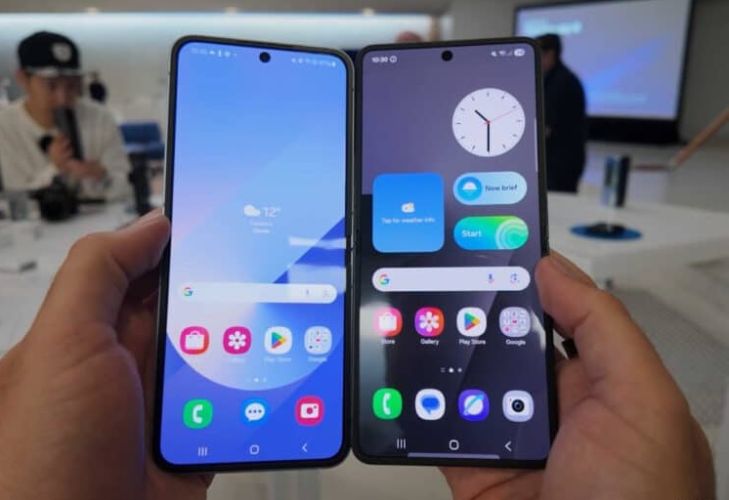
What About the Apple iPhone Fold?
Apple has not yet released a foldable iPhone. Current rumours point to a book-style design opening to approximately the size of an iPad Mini, with a likely late-2026 to early-2027 release window.
Pricing is expected to exceed $2,000. Until it launches and is reviewed, it cannot be responsibly recommended — but its arrival will fundamentally reshape this ranking.
How to Choose: The Right Foldable for Your Life
Buy the Samsung Galaxy Z Fold 7 if:
- You want the slimmest, lightest book-style foldable available
- Samsung’s ecosystem (Galaxy AI, DeX, SmartThings) is already part of your life
- You take a lot of social media and evening photos
Buy the Google Pixel 10 Pro Fold if:
- Camera quality — especially zoom — is your primary concern
- You want the most durable foldable money can buy (IP68)
- Long-term AI software support from Google matters to you
Buy the Motorola Razr Ultra if:
- Battery anxiety is real for you
- You want a phone that fits in every pocket you own
- You resent paying $2,000 for a phone
Buy the Samsung Galaxy Z Flip 7 if:
- You want the premium Samsung flip experience with seven years of updates
- Samsung DeX matters to you
- You want the most polished and supported flip phone available
Frequently Asked Questions
Are foldable phones worth it in 2026?
Which foldable phone has the best camera in 2026?
Do foldable phones break easily?
What is the cheapest foldable phone worth buying in 2026?
Will there be an iPhone foldable in 2026?


Summary: The Best Foldable Phones for 2026
Best Foldable Phones for 2026
| Phone | Best For | Starting Price (USD) | FPI Score |
|---|---|---|---|
| Samsung Galaxy Z Fold 7 | Best overall | $2,000 | Medium |
| Google Pixel 10 Pro Fold | Best cameras + IP68 | $1,799 | Low |
| Motorola Razr Ultra 2025 | Best battery + flip | $1,199 | Low–Medium |
| Samsung Galaxy Z Flip 7 | Best long-term flip | $1,099 | Medium |
For Business Use:
- Samsung Galaxy Z Fold 7 – The Z Fold 7 is the clear business choice. Its 8.0-inch inner display and Samsung DeX support effectively turn it into a portable workstation, replacing both your phone and laptop in meetings.
For General & Personal Use
- Google Pixel 10 Pro Fold For everyday life, the Pixel 10 Pro Fold wins on the metrics that actually matter to most people. It costs $200 less than the Z Fold 7, shoots better photos in real-world conditions, and its full IP68 rating means you don’t have to think twice at the beach
The foldable phone market in 2026 has no bad choices at the top — only different trade-offs. Use the Fold Penalty Index to identify which trade-offs you’re actually willing to make, and let that guide your decision more than any spec sheet.