

Australia’s national broadband operator has begun drawing power from a massive solar installation in Queensland, marking the final piece of an ambitious strategy to run entirely on renewable electricity by year’s end.
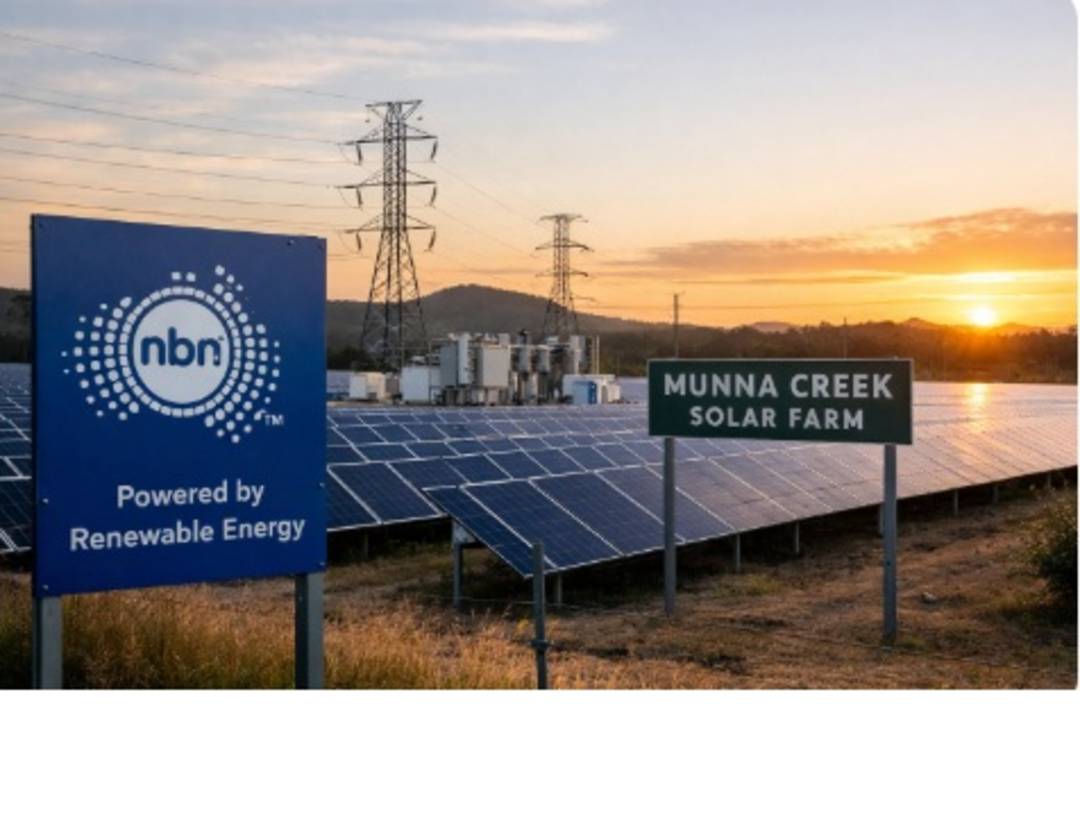
NBN Co activated the Munna Creek Solar Farm on the Sunshine Coast this week, securing 59 gigawatt hours of clean energy annually from the 467-hectare facility near Gympie.
The move completes a trilogy of power purchase agreements designed to eliminate fossil fuels from the company’s electricity consumption starting December 2025.
The solar farm, operated by global energy firm Metlen Energy & Metals, spans more than 255,000 panels across a site capable of powering 41,100 Australian homes. NBN Co has locked in roughly 20 percent of the facility’s total annual output under the agreement.
“This represents a significant milestone in our transition to 100 percent renewable electricity,” NBN Co’s Chief Development Officer for Regional and Remote, Gavin Williams, said at the official opening alongside Metlen’s Ian Kirkham, Head of EPC for Oceania.
The Munna Creek deal follows two earlier renewable contracts that form the backbone of NBN Co’s clean energy push.
A solar farm at West Wyalong in regional New South Wales has been supplying the broadband operator since 2023 under a 10-year agreement covering 90 GWh annually.
In early 2025, NBN Co added wind power to the mix through a six-year deal with AGL tied to the Macarthur Wind Farm in southwestern Victoria, also delivering 90 GWh per year.
Together, the three agreements position NBN Co as the first Australian telecommunications company and first government business enterprise to join RE100, a global coalition of more than 400 major corporations committed to 100 percent renewable electricity.
The renewable electricity target sits within a broader climate strategy validated by the Science Based Targets initiative.
NBN Co has also committed to slashing absolute scope 1 and 2 emissions by 95% by financial year 2030, measured against a 2021 baseline, and maintaining that reduction through 2045. The company is also targeting a 90 percent cut in scope 3 emissions across its value chain by 2045.
NBN Co has set additional supply chain expectations, requiring 80% of suppliers by spend to adopt science-based targets by financial year 2027. The company aims to reach net-zero greenhouse gas emissions across operations and its entire value chain by 2045.
The energy strategy aligns with network infrastructure upgrades as NBN Co extends fibre deeper into communities to meet surging data demand.
The company argues fibre deployment supports lower long-term power consumption while improving service resilience.
By the end of 2025, NBN Co plans to make its Home Hyperfast tier—offering peak wholesale download speeds of 2 Gbps—available to up to 10 million premises, representing roughly 90% of its fixed-line network footprint, subject to service qualification and capacity constraints.
The renewable energy push supports Australia’s national objective of achieving 82% renewable penetration in the electricity grid by 2030 as part of the transition toward net-zero emissions by 2050.
During construction, the Munna Creek project alone supported approximately 150 local jobs in the region.