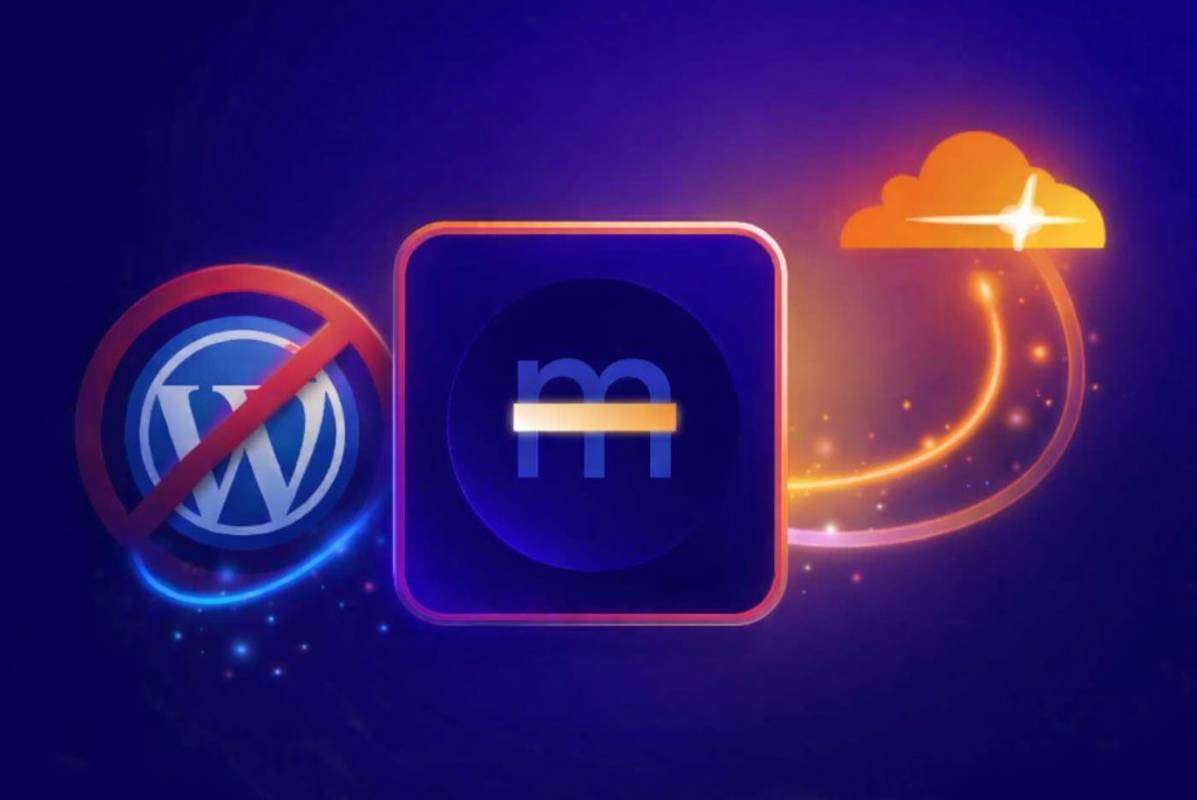
Every few years, the press discovers a new WordPress killer. MDASH is the latest darling making the rounds, promising to finally deliver the death blow to the aging CMS that refuses to die.
Investors are throwing money at it, influencers are breathlessly promoting it, and the usual chorus of hot take artists are declaring WordPress dead on arrival in 2026.
They said the same thing about Webflow. And Wix. And Squarespace. And Ghost. And, every other platform that promised to make WordPress obsolete. WordPress is still running 43% of the internet.
Here’s what everyone promoting MDASH as the WordPress killer fundamentally misunderstands: WordPress isn’t successful because it’s the best tool. It’s successful because it’s the most universal CMS
MDASH might be slicker, faster, easier to use for specific use cases. That doesn’t matter. WordPress won by becoming infrastructure, and you don’t replace infrastructure by being slightly better.
The WordPress ecosystem is worth hundreds of billions of dollars. There are 60,000 plugins. Millions of developers know how to use it. Every hosting company supports it.
Every freelancer can work with it. Every client has heard of it. You can hire someone in any country at any price point who knows WordPress. Try doing that with MDASH in five years.
MDASH’s pitch is always the same pitch: WordPress is bloated, slow, complicated, insecure, outdated. All of these things are true. WordPress is a mess.
It’s a 20-year-old PHP application that started as a blogging platform and got Frankensteined into a full CMS through years of backward-compatible additions.
The codebase is ugly. The admin interface is confusing. The plugin ecosystem is a security nightmare and everyone knows it. Everyone has always known it.
And yet WordPress keeps winning because the mess is a feature, not a bug. The mess means flexibility. You can make WordPress do literally anything.
You want an e-commerce store? WooCommerce. You want a membership site? Pick from 50 plugins. You want to build a job board, a directory, a learning management system, a social network? Someone’s already built a plugin for that.
MDASH has a vision for what websites should look like. WordPress doesn’t care what your website should look like. It’ll become whatever you force it to become.
The other thing these WordPress killers never understand is that WordPress’s market isn’t Silicon Valley startups building the next hot SaaS product. It’s everyone else.
It’s the small business owner who needs a website and doesn’t want to think about it. It’s the freelancer who can charge clients $2,000 to set up a site in a weekend.
It’s the agency that can hire junior developers at $30 an hour because WordPress skills are commodified. It’s the enterprise that picked WordPress in 2012 and has too much invested to migrate.
MDASH is betting that superior technology wins. WordPress already proved that superior technology doesn’t matter. Network effects matter. Ecosystem matters.
Switching costs matter. WordPress has spent 20 years building moats that no amount of venture capital can cross in three years.
Look at what happened to every other WordPress killer. Webflow found product-market fit with designers and agencies building custom sites for clients.
Great business. Didn’t kill WordPress. Squarespace owns the DIY small business market. Huge success. Didn’t kill WordPress. Ghost carved out the newsletter and publication niche.
Smart positioning. Didn’t kill WordPress. They all found their lane because they couldn’t compete with WordPress everywhere, so they competed with WordPress somewhere specific.
MDASH will probably find its lane too. Maybe it’ll be great for certain types of sites. Maybe developers will love it for specific use cases. That’s fine. That’s not killing WordPress. That’s competing in a market that’s big enough for multiple solutions.
The WordPress killer won’t be a better WordPress. It’ll be something that makes websites obsolete entirely. Maybe it’s AI that generates personalised experiences without traditional websites.
Maybe it’s some new protocol that replaces HTTP. Maybe it’s a shift in how humans interact with information online. Whatever kills WordPress won’t look like WordPress at all.
Until then, WordPress will keep running nearly half the internet because it’s good enough, cheap enough, flexible enough, and familiar enough.
MDASH can be better on every technical metric and it won’t matter. The race is already over. WordPress won by becoming boring infrastructure that nobody wants to replace because replacement is expensive and risky and pointless.
The question isn’t whether MDASH will kill WordPress. The question is whether MDASH will still exist in five years when the next WordPress killer shows up promising to finally, truly, definitely make WordPress obsolete this time.
Emdash reflects a modern shift in CMS architecture — serverless, secure, and built with developers in mind. That said, WordPress isn’t disappearing anytime soon.
Its enormous ecosystem of plugins and themes, along with its accessibility for non-technical users, gives it a deeply entrenched position.
The more realistic outlook isn’t that Emdash will “kill” WordPress, but that it will occupy its own space.
It’s well suited for high-performance, custom, and developer-driven builds, while WordPress will likely continue to dominate content-heavy sites, client projects, and small-business websites.
Innovation rarely wipes out the old guard overnight — more often, it reshapes the landscape and creates room for different tools to serve different needs.